

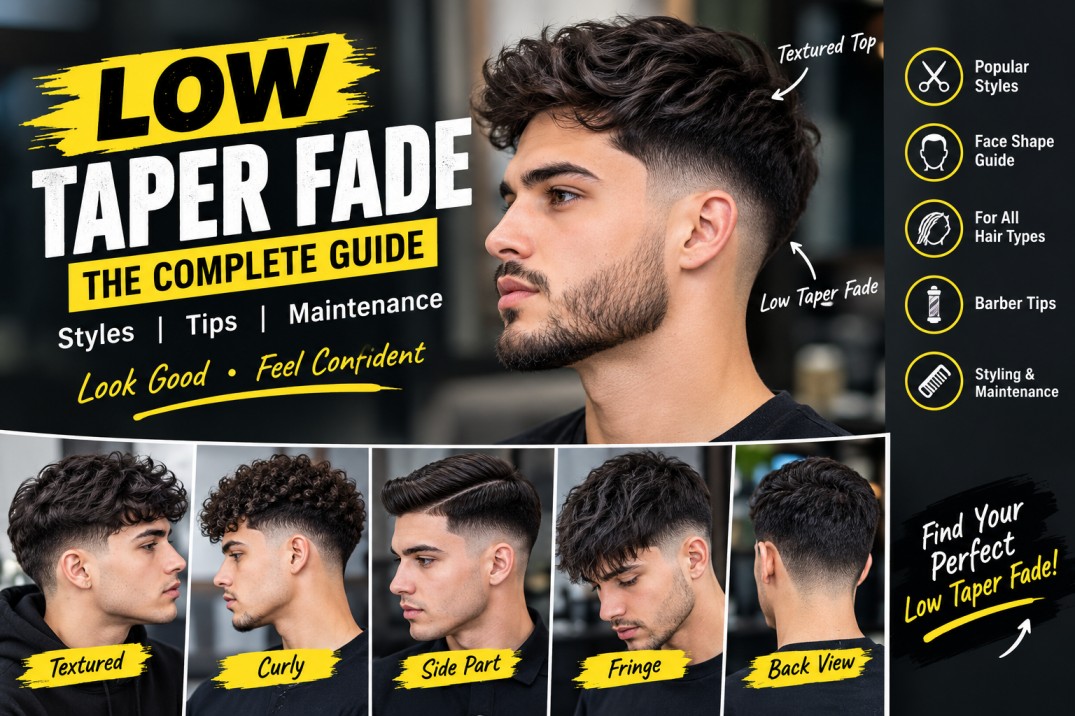
The low taper fade is a versatile men’s haircut that gradually reduces hair length around the sideburns, ears, temples, and neckline. Unlike a higher fade, the transition stays low, preserving more fullness through the sides and top. This creates a clean, balanced appearance that works with classic, modern, textured, curly, and professional hairstyles.
For barbers and clients, understanding the structure of a low taper fade makes the haircut easier to customize. Barbers can adapt the blend to hair texture, density, head shape, and growth patterns, while clients can communicate their preferred height, shortest length, side fullness, and top style more accurately.
What Is a Low Taper Fade?
A low taper fade gradually makes the hair shorter toward the lower perimeter of the head. The shortest area is generally concentrated around the sideburns, above the ears, and neckline, while the upper sides remain relatively full. This localized taper gives the haircut a subtle appearance without removing excessive side weight.
The finish can range from a guarded taper to a zero or skin-close edge, depending on the desired contrast. Because terminology varies between barbers, clients should not rely on the haircut name alone. Explaining the desired length and showing a reference photo can make the final result more predictable.
- Low taper placement
- Gradual hair reduction
- Clean sideburns
- Tapered neckline
- Blended temple area
- Fuller side panels
- Smooth transition
- Customizable finish
Low Taper Fade vs. Low Fade
A low taper fade usually focuses the shortest work on specific perimeter areas, while a conventional low fade creates a more continuous faded band around the lower sides and back. A taper therefore tends to preserve more of the dark, full side panel, giving clients a softer and less dramatic silhouette.
This distinction matters during a barber consultation. Someone asking for a low taper may want clean sideburns and a tapered neckline without losing the fullness above the ears. If a barber extends the fade too far, the finished haircut can look substantially different from the client’s intended design.
- Taper stays compact
- Low fade covers more area
- Taper retains side weight
- Low fade has stronger contrast
- Both use graduated blending
- Placement changes the silhouette
- Shortest length affects contrast
- Reference images help
How Barbers Cut a Low Taper Fade
A professional barber should begin by studying the client’s head shape, hair density, texture, hairline, and natural growth direction. Establishing the taper conservatively provides greater control and reduces the risk of taking the fade too high. The barber should also confirm whether the client wants a natural, zero, or skin-close finish.
The blend is then developed through progressively shorter lengths using clipper guards, lever adjustments, trimmers, and detail work. Controlled flicking motions help soften visible transitions without removing unnecessary weight. The temple, sideburn, ear, and neckline areas require particular attention because small differences can noticeably affect the haircut’s symmetry and silhouette.
- Analyze hair growth
- Check head shape
- Establish taper height
- Start conservatively
- Select appropriate guards
- Blend progressively
- Detail the perimeter
- Check both sides
Clipper Blending Techniques for a Smooth Finish
Effective clipper blending is central to a clean low taper fade. Excessive pressure can remove too much density, so barbers should work with controlled movements and gradually soften darker areas. Flick-out motions are particularly useful because they allow the clipper to leave a softer transition instead of creating another hard guideline.
Different guard lengths and lever positions create intermediate stages between longer and shorter hair. The corners of the blade can provide extra precision around curved temple areas. Trimmers and detailers can refine the perimeter, but the final technique should match the client’s requested level of contrast and scalp exposure.
- Use light pressure
- Master flick-out motion
- Adjust the clipper lever
- Work through guard lengths
- Use blade corners
- Remove dark spots
- Avoid over-fading
- Detail carefully
Low Taper Fade for Different Hair Types
A low taper fade can complement straight, wavy, curly, and coily hair because the taper occupies a relatively small portion of the haircut. Straight hair may make blend imperfections more visible, while waves and curls naturally add movement. Coily textures can retain substantial volume while receiving a cleaner perimeter around the temples and neckline.
Hair density is equally important. Thick hair may require careful bulk management, while fine hair can look thinner if too much side weight is removed. A skilled barber adapts the technique to the individual’s texture, density, and growth pattern instead of applying identical guard numbers to every client.
- Straight hair
- Wavy hair
- Curly hair
- Coily hair
- Fine hair
- Thick hair
- Dense hair
- Textured hair
Low Taper Fade for Face Shapes and Hairstyles
The low taper fade can be adapted to many face shapes because the top remains flexible. Oval, round, square, rectangular, heart-shaped, and diamond-shaped faces can all work with customized versions. The barber can adjust top height, texture, side fullness, and styling direction to create a balanced overall silhouette rather than following rigid face-shape rules.
The taper also pairs with numerous hairstyles, including textured crops, fringes, quiffs, side parts, slick backs, curls, waves, buzz cuts, and longer tops. Clients should consider their daily styling routine as well as appearance. A good haircut should not only look impressive immediately after leaving the barbershop but also remain practical at home.
- Oval face
- Round face
- Square face
- Long face
- Heart-shaped face
- Textured crop
- Curly top
- Modern quiff
How to Ask Your Barber for a Low Taper Fade
Clients can improve their haircut experience by describing the desired result rather than simply saying, “Give me a low taper.” Explain how low the taper should sit, how much fullness should remain above the ears, how short the lowest section should be, and what you want on top. This gives the barber practical design information.
A reference photograph is one of the easiest ways to communicate the overall silhouette. Clients should also clarify whether they want skin, zero, 0.5, or a longer guarded finish. Since clipper guard terminology and haircut names can vary, combining a photo with specific preferences can reduce misunderstandings.
- Say “low taper”
- Specify taper height
- Mention side fullness
- Choose shortest length
- Explain neckline preference
- Describe top length
- Bring a reference photo
- Confirm before cutting
Low Taper Fade Maintenance, Styling, and Professional Tips
A low taper fade is relatively easy to maintain because the shortest sections are concentrated around the perimeter. However, clients who want a consistently sharp appearance should refresh the taper regularly. Hair growth rate, clipper length, neckline shape, and personal preference all affect how often the client should return for a professional touch-up.
Styling usually focuses more on the longer hair on top than on the tapered area. Depending on texture and desired finish, clients can use styling cream, matte clay, curl cream, mousse, or pomade. Barbers can also explain simple home-styling techniques and record client preferences to make future appointments more consistent.
- Schedule regular touch-ups
- Keep sideburns neat
- Maintain the neckline
- Use suitable styling products
- Match products to hair texture
- Avoid excessive product buildup
- Learn simple styling techniques
- Record haircut preferences
Final Thoughts
The low taper fade combines a clean perimeter with flexible styling and natural-looking side fullness. Its low placement makes it suitable for clients who want a polished haircut without the broader contrast of a traditional low fade. It can be adapted to straight, wavy, curly, and coily hair and paired with many modern men’s hairstyles.