

What Is an Experience Calculator?
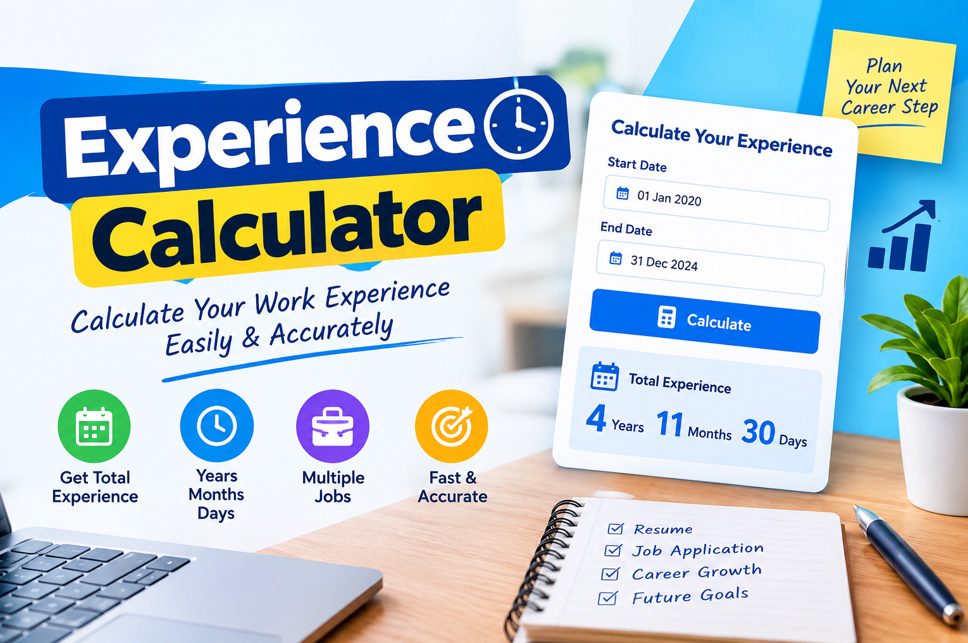
An Experience Calculator is a simple online tool that helps users calculate the total duration of their professional or personal experience. Instead of manually counting years, months, and days between dates, you can enter a start date and end date to get an accurate result within seconds.
Whether you are preparing a resume, applying for a job, checking eligibility for a position, or tracking your career history, an experience calculator can make date calculations easier. It is especially useful when you have multiple employment periods and want to understand your overall professional experience.
An Experience Calculator is a date-based calculation tool designed to determine how much experience a person has gained over a specific period. It generally uses a starting date and ending date to calculate the duration in years, months, and days. Some advanced calculators can also combine several employment periods.
The tool eliminates the need for complicated calendar calculations. By automatically considering different month lengths and leap years, it can provide a convenient estimate of experience duration. This makes it useful for employees, students, job seekers, recruiters, freelancers, and anyone who needs to calculate time between two dates.
- Calculates employment duration
- Measures professional experience
- Shows years and months
- Calculates remaining days
- Supports date-based calculations
- Reduces manual counting
- Helps organize career history
- Provides quick results
How Does an Experience Calculator Work?
An experience calculator typically works by comparing a start date with an end date. The calculator processes the difference between these dates and converts it into a readable duration, such as 5 years, 7 months, and 12 days. The calculation is based on calendar dates rather than simple numerical subtraction.
Some tools also allow users to enter multiple jobs or experience periods. In that situation, each period can be calculated separately and then combined to estimate total experience. This feature is particularly helpful for people whose careers include several companies, internships, projects, or employment gaps.
- Enter the starting date
- Select the ending date
- Process the dates
- Calculate date difference
- Convert days into duration
- Combine multiple periods
- Review the final result
- Verify important dates
How to Use Experience Calculator
Using an Experience Calculator is generally straightforward. First, enter the date when your employment, internship, project, or other experience began. Next, provide the ending date. If you are still working in that position, many calculators allow you to use the current date as the end date.
After entering the information, click the calculate button. The tool will display your experience duration, often in years, months, and days. For multiple jobs, repeat the process for every employment period and use a total experience feature if the calculator provides one.
- Open the calculator
- Enter your start date
- Enter your end date
- Select the correct date format
- Click Calculate
- Check the duration
- Add other experience periods
- Save the result
Benefits of Experience Calculator
One of the main benefits of an Experience Calculator is convenience. Manually calculating career duration can become confusing when employment spans different months, years, or leap years. A calculator performs the date difference automatically, helping users obtain results faster while reducing common counting mistakes.
The tool can also support career planning and documentation. Job applicants can use it when preparing resumes or application forms, while professionals can maintain an accurate record of their employment history. Recruiters and HR teams may also find date calculations useful when reviewing candidate experience.
- Saves valuable time
- Reduces calculation errors
- Simplifies date differences
- Supports resume preparation
- Helps track employment
- Useful for HR calculations
- Handles calendar variations
- Improves record keeping
Why Accurate Experience Calculation Matters
Accurate experience calculation can be important when a job description requires a specific amount of professional experience. For example, a position may request two years, five years, or more of relevant work history. Knowing your exact employment duration helps you determine whether your background meets the stated requirement.
Correct calculations are also useful when completing applications and professional documents. Overestimating experience can create inconsistencies, while underestimating it may prevent you from presenting your qualifications properly. An experience calculator provides a consistent way to review dates and understand your career timeline.
- Confirms employment duration
- Helps meet job requirements
- Supports accurate resumes
- Improves application accuracy
- Prevents date confusion
- Clarifies career timelines
- Helps verify work history
- Supports professional documentation
Experience Calculator for Multiple Jobs
Many professionals have worked for several organizations throughout their careers. Calculating total experience manually can be challenging because different jobs may overlap or contain gaps. A multiple-experience calculator can process individual employment periods and help users determine the combined duration of their work history.
When using multiple periods, it is important to enter the correct joining and leaving dates for every position. Overlapping employment periods should be reviewed carefully because simply adding every duration together may count the same calendar period more than once. Accurate input is therefore essential for meaningful results.
- Add each employment period
- Enter accurate joining dates
- Enter leaving dates
- Review overlapping jobs
- Identify career gaps
- Calculate individual durations
- Combine eligible periods
- Verify total experience
Experience Calculator for Resume and Job Applications
An Experience Calculator for resumes can help job seekers understand how to present their professional background. Instead of guessing the total length of employment, applicants can calculate each position and organize their career history more accurately. This can make employment information clearer and easier to review.
For job applications, the calculated duration can also help when a form asks for total years of experience. However, users should always follow the employer’s definition of relevant experience. Some employers count only full-time professional work, while others may include internships, part-time work, freelance projects, or related experience.
- Prepare accurate work history
- Calculate career duration
- Organize employment dates
- Support job applications
- Improve resume accuracy
- Identify relevant experience
- Check eligibility requirements
- Avoid unsupported claims
Tips for Getting Accurate Results
The quality of an experience calculation depends largely on the information entered. Always double-check joining dates, resignation dates, project dates, and other relevant information before calculating. A single incorrect date can change the final duration, particularly when calculating shorter periods.
It is also helpful to understand what the result represents. Calendar-based experience and total working days are not always identical. Holidays, weekends, unpaid leave, overlapping employment, and organizational definitions may affect how professional experience is interpreted. Use the calculator as a practical date-calculation aid and verify special requirements when necessary.
- Double-check every date
- Use the correct date format
- Avoid typing mistakes
- Check employment records
- Review overlapping periods
- Consider career gaps
- Understand employer requirements
- Verify unusual results
Common Uses of an Experience Calculator
An Experience Calculator has applications beyond traditional employment. Students can calculate internship durations, freelancers can track project periods, and professionals can measure experience in a particular field. It can also be useful for calculating the duration of volunteering, training, apprenticeships, or other time-based activities.
The tool is particularly valuable whenever accurate date differences are needed. Instead of relying on mental arithmetic or manually counting calendar months, users can enter the relevant dates and receive a structured result. This makes experience calculation faster, more convenient, and easier to understand.
- Employment tracking
- Internship duration
- Freelance projects
- Professional training
- Apprenticeships
- Volunteer experience
- Career planning
- Job eligibility checks