

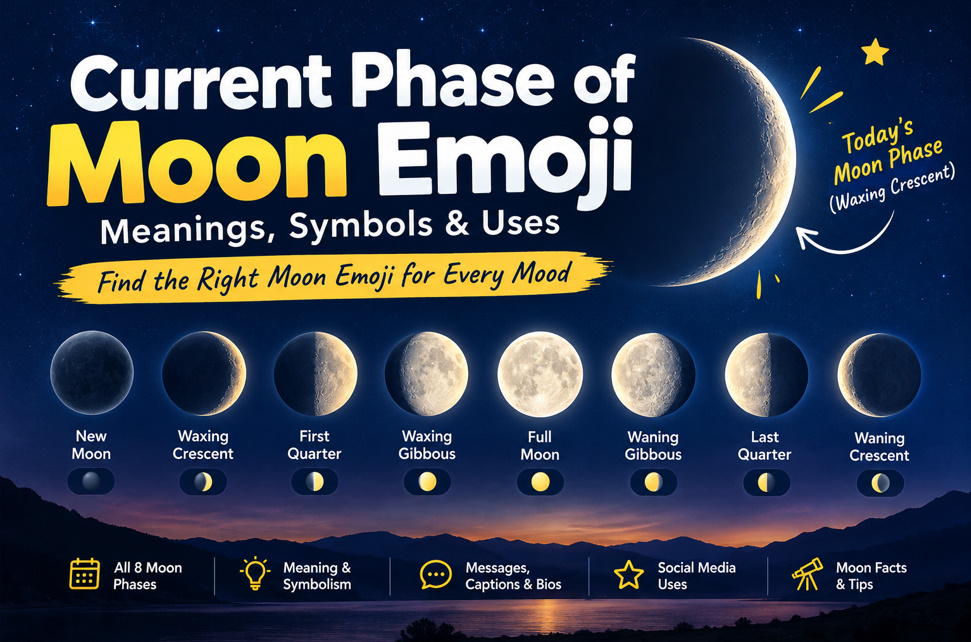
What Is the Current Phase of Moon Emoji?
The current phase of moon emoji refers to using moon symbols to represent the Moon’s appearance during different stages of its lunar cycle. Popular moon emojis include 🌑, 🌒, 🌓, 🌔, 🌕, 🌖, 🌗, and 🌘. Each symbol represents a different illuminated portion of the Moon, making it easy to express lunar themes in digital conversations.
People use moon phase emojis in text messages, social media captions, astronomy discussions, and nighttime posts. These symbols are also popular among users who enjoy astrology, celestial aesthetics, and nature-inspired designs. However, an emoji does not automatically update with the real Moon’s phase; you need to check a lunar calendar to identify the current phase accurately.
- 🌑 New moon
- 🌒 Waxing crescent
- 🌓 First quarter
- 🌔 Waxing gibbous
- 🌕 Full moon
- 🌖 Waning gibbous
- 🌗 Last quarter
- 🌘 Waning crescent
What Is the Current Moon Phase Today?
On October 14, 2026, the Moon is in its waxing crescent phase, with approximately 12–14% of its visible disk illuminated in Pakistan, depending on the location and observation time. This means the Moon is gradually becoming more visible following the new moon on October 10.
Time and Date
+1
The best emoji to represent this phase is 🌒, although the exact appearance of the Moon can differ from the emoji displayed on your device. The waxing crescent symbolizes growth, beginnings, and gradual change in many creative contexts. For precise astronomical information, check a current moon phase calendar for your location.
- Current phase: Waxing crescent
- Suggested emoji: 🌒
- Previous phase: New moon
- Next major phase: First quarter
- Moon illumination: Approximately 12–14% in Pakistan
- Lunar cycle: Approximately 29.5 days
- Best reference: A local lunar calendar
- Popular use: Daily moon updates
Meaning of Each Moon Phase Emoji
Moon phase emojis help communicate the changing appearance of the Moon without requiring a detailed astronomical explanation. The eight primary symbols illustrate the progression from a nearly invisible new moon to a fully illuminated full moon and back again. They are useful for astronomy content, educational posts, nighttime messages, and celestial-themed designs.
Each emoji has a distinct visual appearance, but its symbolic meaning depends on the context. For example, 🌑 may represent darkness or a fresh beginning, while 🌕 often suggests brightness, completion, or a beautiful night sky. These interpretations are creative associations rather than fixed scientific definitions.
- 🌑 — New moon
- 🌒 — Waxing crescent
- 🌓 — First quarter
- 🌔 — Waxing gibbous
- 🌕 — Full moon
- 🌖 — Waning gibbous
- 🌗 — Last quarter
- 🌘 — Waning crescent
Difference Between Waxing and Waning Moon Emojis
Waxing and waning describe whether the visible illuminated portion of the Moon is increasing or decreasing. During the waxing phases, the Moon appears progressively brighter from one night to the next. During the waning phases, the illuminated portion gradually decreases as the lunar cycle moves toward another new moon.
Understanding these terms makes it easier to select the correct moon phase emoji for a caption or astronomy update. The symbols 🌒, 🌓, and 🌔 represent stages of waxing, whereas 🌖, 🌗, and 🌘 represent stages of waning. Remember that the Moon’s actual orientation depends on the observer’s location.
- Waxing means increasing illumination.
- Waning means decreasing illumination.
- 🌒 represents a waxing crescent.
- 🌔 represents a waxing gibbous.
- 🌖 represents a waning gibbous.
- 🌘 represents a waning crescent.
- 🌑 represents the new moon.
- 🌕 represents the full moon.
How to Use Moon Phase Emojis on Social Media
Moon emojis are popular across social media platforms because they add personality and visual interest to short messages. You can use them in Instagram captions, TikTok descriptions, Facebook posts, WhatsApp messages, and other digital conversations. They also work well in astronomy updates, nighttime photography captions, and posts about the natural world.
For more informative content, combine the relevant moon emoji with the date and phase name. This approach helps readers understand whether your post describes the current lunar phase or simply expresses a mood. If you publish daily astronomy content, verify the phase before posting instead of reusing the same symbol every day.
- Instagram moon captions
- WhatsApp status updates
- TikTok nighttime posts
- Facebook astronomy content
- Daily lunar calendar updates
- Stargazing photography captions
- Celestial-themed profile bios
- Nature-inspired digital designs
Moon Phase Emojis for Aesthetic Captions
Moon phase emojis can create a calm, dreamy, mysterious, or celestial atmosphere in social media captions. Their simple shapes pair naturally with stars, clouds, nighttime photographs, and dark-themed designs. Many people also use moon symbols in digital journals, planners, wallpapers, and messages that reflect their appreciation for nature and the night sky.
For an attractive caption, choose a moon emoji that complements your photograph rather than focusing only on its symbolic meaning. A crescent moon can suit a quiet evening scene, while a full moon may complement a bright lunar photograph. You can also combine moon symbols with stars to create a consistent celestial aesthetic.
- “Under the moonlight 🌙”
- “A little lunar magic 🌒”
- “Chasing moonlit skies 🌕”
- “Written in the stars ✨”
- “Hello, peaceful night 🌙”
- “Celestial dreams 🌌”
- “One night, endless wonder 🌔”
- “Following the lunar cycle 🌑”
How to Find the Correct Moon Phase Emoji
Finding the right moon emoji begins with checking the Moon’s actual phase on your chosen date. A moon phase calendar provides information about the new moon, first quarter, full moon, and last quarter, along with the intermediate waxing and waning stages. Some astronomical calendars also provide illumination percentages and local moonrise and moonset times.
After identifying the phase, select the closest matching emoji from your device’s emoji keyboard. Keep in mind that emoji designs vary between operating systems, and the displayed symbol is not a live astronomical indicator. For educational articles, use the phase name and date alongside the emoji to make your information clearer and more reliable.
- Check a reliable lunar calendar.
- Confirm the date and local time.
- Identify the current lunar phase.
- Review the Moon’s illumination percentage.
- Select the matching emoji.
- Add the phase name to your caption.
- Verify the information before publishing.
- Update the symbol as the Moon changes.
Frequently Asked Questions About Moon Phase Emojis
Moon phase emojis are easy to use once you understand the difference between the symbols and the astronomical events they represent. Whether you are searching for today’s moon emoji, creating a lunar calendar, or writing an astronomy blog post, choosing an appropriate symbol helps communicate your message quickly.
One important distinction is that a moon emoji is a standardized digital character, not a real-time image of the sky. The Moon’s appearance changes continuously, while the emoji on your phone remains unchanged until you select a different one. Use a current lunar calendar whenever accuracy matters.
- What is the current phase of moon emoji? On October 14, 2026, 🌒 is a suitable approximation for the waxing crescent phase in Pakistan.
- Which emoji represents a full moon? 🌕 represents the full moon.
- Which emoji represents a new moon? 🌑 represents the new moon.
- What does 🌒 mean? It represents the waxing crescent phase.
- Does the moon emoji update automatically? No, it does not update with the real lunar cycle.
- How long is one lunar cycle? Approximately 29.5 days.
- Can moon emojis be used for astronomy posts? Yes, especially when paired with accurate phase information.
- Where can I check today’s moon phase? Use a reliable astronomical calendar that provides dates and local lunar information.