
Enye Small Big Letters: Everything You Need to Know
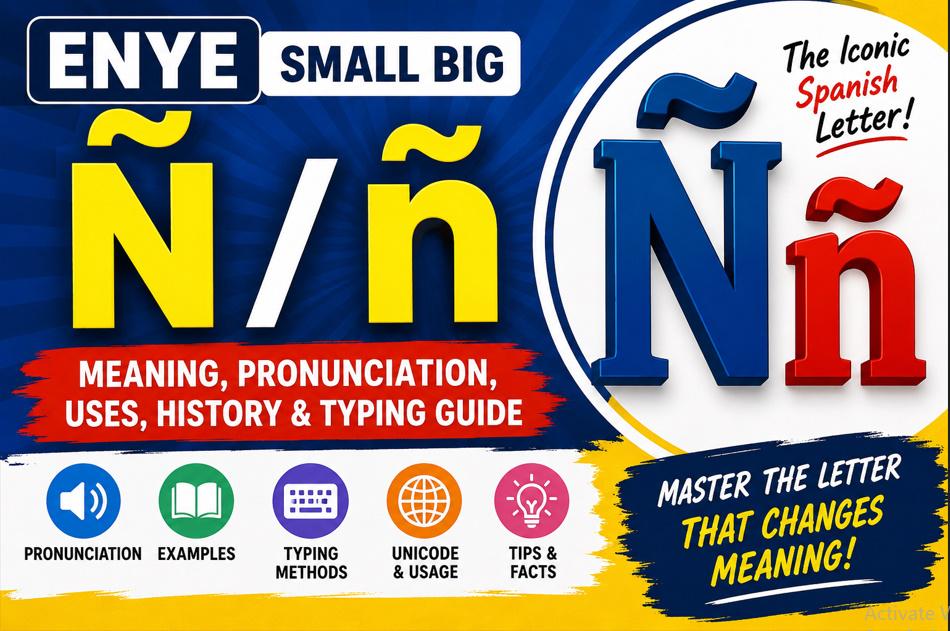
The Enye Small Big Letters refer to the uppercase Ñ and lowercase ñ, two important characters in the Spanish alphabet. Although they resemble the English letter N, the small tilde placed above them gives them a completely different pronunciation and meaning. These letters are recognized as independent alphabet characters rather than decorative variations.
Today, Enye Small Big Letters are used by hundreds of millions of Spanish speakers worldwide. They appear in books, educational materials, official documents, websites, maps, passports, dictionaries, and everyday conversations. Learning how these letters work is valuable for language learners, students, teachers, translators, and developers.
What Are Enye Small Big Letters?
The uppercase letter is written as Ñ, while the lowercase version is ñ. Together they are known as the Enye because of their pronunciation. These letters are considered essential components of the Spanish writing system and cannot be replaced with the regular English letter N.
Using the correct letter preserves spelling, pronunciation, and meaning. A missing tilde may completely change a word and sometimes create misunderstandings in communication. That is why Spanish writing always treats Ñ and ñ with great importance.
Key Points
- Ñ is uppercase.
- ñ is lowercase.
- Both are official letters.
- Different from N.
- Used in Spanish.
- Found in dictionaries.
- Appears in names.
- Used in education.
- Important for spelling.
- Supported worldwide.
Why Enye Small Big Letters Are Unique
Few alphabet letters are instantly recognized around the world the way the Enye is. The tilde above the letter creates a unique sound that does not exist in standard English. This makes it one of the most recognizable symbols of Spanish culture and language.
Unlike accented vowels, the Enye is not simply a modified character. It functions as an independent alphabet letter with its own pronunciation, dictionary position, and linguistic importance. This uniqueness has helped it remain a defining feature of Spanish for centuries.
Key Points
- Has a distinctive tilde.
- Produces a unique sound.
- Separate alphabet letter.
- Recognized internationally.
- Represents Spanish identity.
- Different dictionary entry.
- Changes pronunciation.
- Changes meanings.
- Easy to recognize.
- Culturally important.
History and Development of the Enye
The Enye has an interesting historical background that dates back to medieval Europe. Scribes copied handwritten books by placing a small N above another N to shorten words and save valuable writing space on expensive manuscripts.
Over many generations, the small handwritten N gradually evolved into the curved tilde that appears today. Eventually, Spanish scholars officially accepted the new character, making it a permanent part of the alphabet.
Key Points
- Medieval origin.
- Used by scribes.
- Saved writing space.
- Developed naturally.
- Derived from NN.
- Standardized later.
- Preserved by scholars.
- Used for centuries.
- Historical importance.
- Still used today.
Pronunciation of Enye Small Big Letters
The sound produced by Ñ is often compared to the “ny” sound in the English word “canyon.” Although similar, the Spanish pronunciation is smoother and is produced naturally by native speakers in everyday conversation.
Practicing pronunciation with common vocabulary helps learners develop confidence. Listening to native speakers, repeating words aloud, and reading Spanish sentences all improve pronunciation accuracy over time.
Key Points
- Similar to “ny.”
- Different from N.
- Used daily.
- Easy with practice.
- Important for speaking.
- Helps listening skills.
- Common in vocabulary.
- Improves fluency.
- Used in names.
- Essential for learners.
Common Examples of Enye Small Big Letters
Many familiar Spanish words include the Enye. These words appear frequently in textbooks, newspapers, television, travel guides, menus, and classroom materials, making them useful examples for beginners.
Some of the best-known words include niño, niña, mañana, señor, señora, España, baño, piñata, año, and sueño. Learning these words helps students quickly recognize the Enye in real situations.
Key Points
- Niño
- Niña
- Año
- Mañana
- Señor
- Señora
- España
- Baño
- Sueño
- Piñata
How to Type Enye Small Big Letters
Typing uppercase Ñ and lowercase ñ is easy on modern devices. Windows, macOS, Android, Linux, and iPhone all include built-in keyboard support, making the characters available without additional software.
When a keyboard lacks Spanish characters, users can rely on Unicode values, Alt codes, character maps, copy-and-paste methods, or online Enye generators. These options make the letters accessible anywhere.
Key Points
- Windows shortcuts.
- Mac shortcuts.
- Android support.
- iPhone support.
- Unicode available.
- HTML compatible.
- Copy and paste.
- Character map.
- Online generators.
- Language keyboards.
Digital Importance of Enye Small Big Letters
Modern computers store every character using Unicode standards. This allows Enye Small Big Letters to display correctly across websites, applications, databases, emails, and social media without losing their proper appearance.
Software developers, content creators, translators, and website owners rely on Unicode compatibility to maintain accurate multilingual content. Proper encoding also improves user experience and search engine readability.
Key Points
- Unicode compatible.
- UTF-8 support.
- Used online.
- Works in software.
- Database friendly.
- HTML supported.
- Search engine friendly.
- Mobile compatible.
- Browser compatible.
- Cross-platform support.
Benefits of Learning Enye Small Big Letters
Understanding Enye Small Big Letters makes learning Spanish much easier. Students become better readers, writers, and speakers while avoiding common spelling and pronunciation mistakes that occur when Ñ is replaced by N.
Knowledge of these letters also helps professionals working in education, translation, software development, tourism, publishing, and international communication. It is a small detail that produces a significant improvement in language accuracy.
Key Points
- Better spelling.
- Better pronunciation.
- Improved reading.
- Stronger writing.
- Easier translation.
- Better communication.
- Supports education.
- Useful for travel.
- Helpful for professionals.
- Builds language confidence.
Conclusion
The Enye Small Big Letters—uppercase Ñ and lowercase ñ—are among the most recognizable symbols of the Spanish language. Their distinctive pronunciation, fascinating history, and widespread use make them essential for anyone studying or working with Spanish. They are not simply decorative characters but independent alphabet letters with unique linguistic value.
Whether you are typing documents, learning vocabulary, creating multilingual websites, or communicating with Spanish speakers, mastering Enye Small Big Letters will improve your accuracy and confidence. Understanding these remarkable letters is an important step toward appreciating both the Spanish language and its rich cultural heritage.