

Introduction
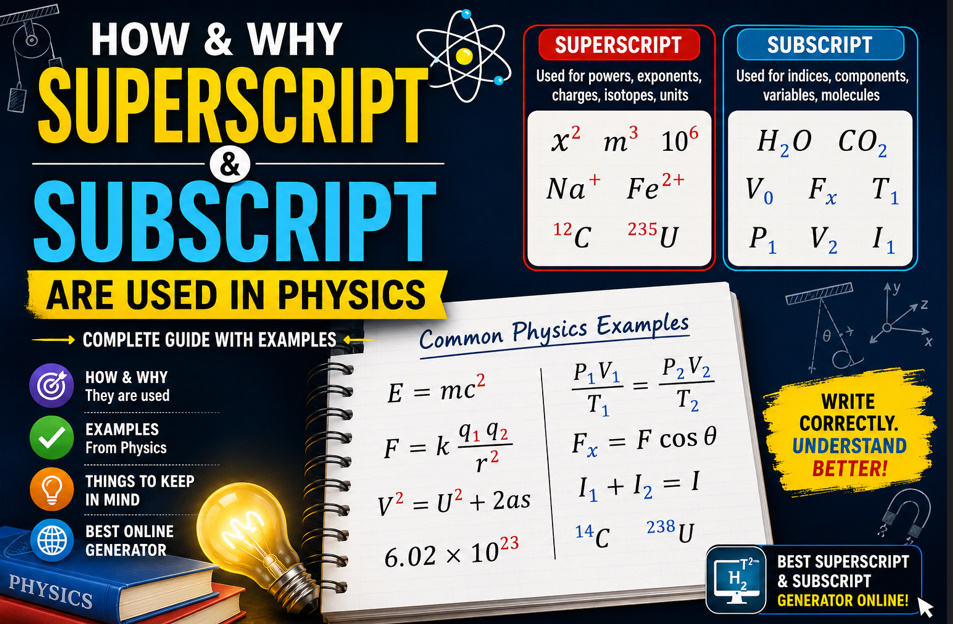
Physics is a subject filled with mathematical equations, scientific symbols, units, and variables. To write these expressions correctly, superscripts and subscripts play an essential role. Without proper formatting, many physics formulas become confusing or even incorrect.
Whether you are a student, teacher, researcher, or content creator, understanding the correct use of superscript and subscript improves readability, accuracy, and professionalism. This guide explains where these formatting styles are used, why they matter, and how an online superscript and subscript generator can simplify your work.
What Are Superscripts and Subscripts?
A superscript is a character written slightly above the normal text line. It is commonly used for exponents, powers, electric charges, and isotopes.
Examples:
- m²
- cm³
- x²
- 10⁶
- Na⁺
- Fe³⁺
A subscript is a character written below the normal text line. It is mainly used for chemical formulas, variable labels, indices, and component notation.
Examples:
- H₂O
- CO₂
- V₀
- Fₓ
- T₁
- I₂
Using the correct formatting helps readers immediately understand the meaning of scientific notation.
Why Superscript Is Important in Physics
Superscripts appear throughout physics because they represent mathematical operations and scientific notation.
Some common uses include:
Exponents
- x²
- r³
- t⁴
Units
- m² (square meter)
- cm²
- m³ (cubic meter)
Scientific Notation
- 5 × 10⁸
- 3.2 × 10⁻⁶
- 9.81 × 10²
Electric Charges
- Na⁺
- Cl⁻
- Fe²⁺
- Mg²⁺
Isotopes
- ¹²C
- ¹⁴C
- ²³⁵U
These symbols allow scientists to communicate complex information clearly and universally.
Why Subscript Is Important in Physics
Subscripts help distinguish variables that represent different objects, directions, or conditions.
Common examples include:
Initial and Final Values
- V₀ (initial velocity)
- T₁
- T₂
Components of Vectors
- Fₓ
- Fᵧ
- F𝓏
Indexed Variables
- a₁
- a₂
- x₁
- x₂
Current and Voltage
- I₁
- I₂
- V₁
- V₂
Gas Laws and Thermodynamics
- P₁
- P₂
- T₁
- T₂
Subscripts make equations much easier to interpret.
Common Physics Examples Using Superscripts and Subscripts
Below are examples that students frequently encounter.
Newton’s Laws
- F = ma
Kinematic Equation
- V² = U² + 2as
Coulomb’s Law
- F = kq₁q₂/r²
Einstein’s Equation
- E = mc²
Ideal Gas Law
- P₁V₁/T₁ = P₂V₂/T₂
Scientific Notation
- 6.02 × 10²³
Isotopes
- ¹⁴C
- ²³⁸U
These equations demonstrate how superscripts and subscripts work together in scientific writing.
Things to Keep in Mind While Generating Superscript and Subscript
Whether using Microsoft Word, Google Docs, LaTeX, or an online generator, follow these best practices.
Maintain Accuracy
A misplaced superscript or subscript can completely change the meaning of an equation.
Use Unicode-Compatible Characters
Unicode superscripts and subscripts display correctly on most websites, documents, and devices.
Avoid Mixing Formatting Styles
Use consistent notation throughout your document.
Check Scientific Meaning
Always verify that exponents, indices, and charges are placed correctly.
Preserve Readability
Avoid overcrowding formulas with excessive formatting.
Copy Carefully
Some applications may lose formatting during copy-paste. Always double-check after pasting.
Test Across Devices
Ensure the symbols display properly on mobile phones, tablets, and desktop computers.
Follow Academic Standards
Schools, colleges, and journals often have formatting guidelines. Follow the required style.
Best Online Superscript and Subscript Generator
If you frequently write physics equations, using an online generator saves time and reduces formatting errors.
A good superscript and subscript generator should provide:
- Instant conversion
- Unicode support
- One-click copy
- Mobile compatibility
- Free access
- No installation required
- Fast processing
- Accurate character generation
- Support for numbers, letters, and symbols
- Easy-to-use interface
Such tools are especially useful for students preparing assignments, teachers creating worksheets, researchers writing papers, and bloggers publishing scientific content.
Benefits of Using an Online Generator for Physics
Online generators simplify scientific writing in many ways.
Some major benefits include:
- Saves valuable time.
- Produces accurate formatting.
- Improves readability.
- Reduces typing mistakes.
- Works on all devices.
- Ideal for social media and websites.
- Useful for homework and assignments.
- Supports professional documentation.
- Easy to copy and paste.
- Requires no software installation.
These advantages make online generators a practical choice for anyone working with physics notation.
Frequently Asked Questions
Can I use superscript in physics equations?
Yes. Superscripts are commonly used for exponents, powers, scientific notation, electric charges, and isotope notation.
Where are subscripts used in physics?
Subscripts identify variables, initial and final values, vector components, and indexed quantities.
Why are superscripts and subscripts important?
They improve clarity, prevent misunderstandings, and ensure scientific accuracy in equations and formulas.
Can I copy superscript and subscript characters online?
Yes. Many online generators let you convert normal text into Unicode superscript or subscript characters that can be copied and pasted anywhere.
Which is the best superscript and subscript generator?
The best generator is one that offers instant Unicode conversion, supports both superscript and subscript characters, works on all devices, and allows one-click copying. It should be free, fast, and easy to use for physics equations, chemistry formulas, mathematics, and educational content.
Conclusion
Superscripts and subscripts are fundamental elements of physics notation. They help represent exponents, indices, units, isotopes, electric charges, vector components, and scientific notation accurately. Proper formatting improves communication, reduces errors, and makes scientific documents easier to read.
For students, educators, researchers, and content creators, an online superscript and subscript generator provides a quick and reliable way to create correctly formatted scientific text. By following the best practices outlined in this guide, you can produce professional-looking equations and ensure your physics work is both accurate and easy to understand.